

Budget Review
Autumn 2024

With the Labour Government recently in situ, the new Chancellor of the Exchequer, Rachel Reeves came to Parliament to deliver her first Budget. The Chancellor’s stated aim with this Budget was to “fix the foundations and deliver change” and “invest, invest, invest”. To do this there would be a need to raise an additional £40 billion in taxes.
Stated below are some of the main announcements that have come out of this Budget.

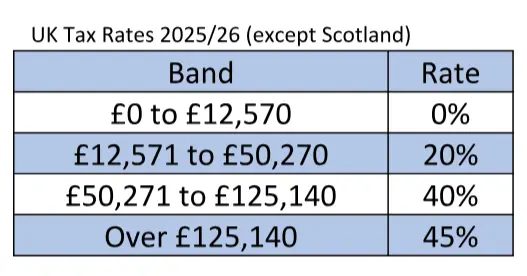
Income Tax Allowance + National Insurance + Rate Bands
Please be aware that since 1999 the Scottish Parliament started to have tax raising powers. Nowadays, it can vary the tax rates and thresholds of Non-Savings, Non-Dividend income for Scottish taxpayers. The differential between Scotland and the rest of the UK in this respect has grown quite significantly as demonstrated by the chart below. This makes things even more complicated for Scottish taxpayers when looking at carrying out any legitimate form of tax planning. The Scottish Budget is set for Wednesday, 4th December 2024.
Tip
If you are a director/shareholder resident in Scotland, as the tax rates on Non-Savings and Non-Dividend income are noticeably higher than in the rest of the UK you may find it tax-efficient to pay out more in dividend than in salary.
The Wales Act 2014 gave the National Assembly of Wales the first taste of tax-raising powers and, like Scotland, they too can vary the tax rates in respect of Welsh resident taxpayers as regards Non-Savings and Non-Dividend income. However, to date, they have continued to set income tax rates in line with those announced by the UK Government. The Welsh Government is planning to publish the detailed draft Budget on 10th December 2024 and the final Budget on 25th February 2025.
The Income Tax Personal Allowance and all other elements of the Income Tax system remain part of the Chancellor’s responsibility.
Under the previous Government, the Personal Tax Allowance and the rate bands were frozen until April 2028. The Labour Government has stated they will not extend the freeze beyond that date but intends to increase allowances and rate bands in line with the rate of inflation from that date. Personal allowances will continue to be reduced by £1 for every £2 a person’s income exceeds £100,000.
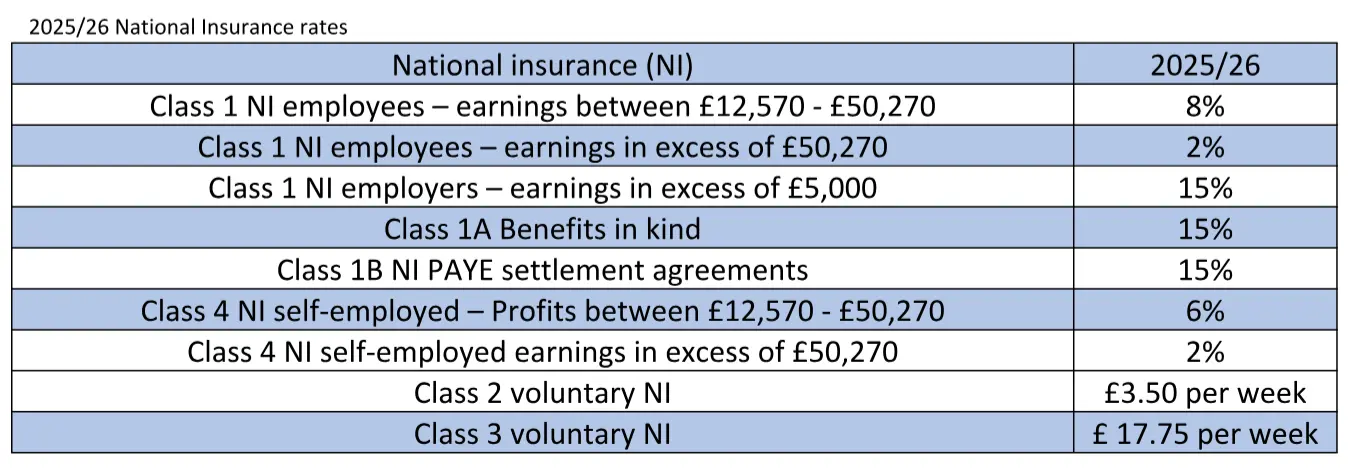
From April 2025 the employer’s national insurance contributions on earnings is to increase from 13.8% to 15% with the Employer’s Secondary Threshold trigger point starting from £5,000 as opposed to the present threshold limit of £9,100.
The Employment Allowance (EA) is a Government initiative that allows eligible employers to reduce their National Insurance liability. From April 2025 the EA will increase from £5,000 to
£10,500.

Quick tips
With the increase in the employers national insurance rate from April 2025, the employer may want to consider bringing forward bonus payments into this tax year as opposed to the 2025/26 tax year.
If you have more than one employment you may pay too much employees national insurance. HM Revenue & Customs can request the second employer to operate a lower rate to ensure the correct amount is paid. Refunds may be possible if national insurance has been overpaid in earlier years.
If you are a sole trader or property landlord and your turnover (pre expenses) exceeds £50,000 during the 2024/25 tax year you may need to be Making Tax Digital for Income Tax (MTD) compliant from April 2026 which will require quarterly reporting. If you are both a sole trader and a property landlord then you aggregate the two turnovers together when applying the £50,000 threshold. Are you ready for this? If not we can help.
Options to consider to avoid having to be MTD compliant might be creating a partnership or incorporating the business.
Dividends

- The zero rate tax dividend threshold will remain at £500 from 6th April 2025.
- There will be no change to the dividend tax rates.

Furnished Holiday Letting (FHL)

- The announcement that the FHL regime was to be abolished was in the Spring 2024 Budget. However, it did not get enacted before the General Election came about.
- However, the Labour Government has since confirmed its demise.
- FHL will be treated the same as long-term lets from April 2025 as regards income tax.
- Loan interest relief will be restricted to a 20% income tax credit from April 2025.
- Where an existing FHL business has an ongoing capital allowances pool of expenditure, it can continue to claim writing down allowances on that pool post-April 2025 but not in respect of new expenditure after that date.
- There is an anti-forestalling rule which, with minor exceptions, prevents FHL owners obtaining capital gains relief through the use of unconditional contracts with effect from 6th March 2024.
- FHL income will not be counted as relevant income for pension contribution purposes from 6th April 2025 onwards.
- Certain capital gains tax reliefs will cease from April 2025 except where the FHL conditions are satisfied up to April 2025 and the criteria for that particular relief includes conditions which can still come into play post-April 2025.
- Where the FHL business ceased prior to 6th April 2025, business asset disposal relief (the 10% capital gains tax rate) may still apply to a disposal of the property within 3 years of the FHL business coming to an end.
Quick tips
If you are servicing debt on your furnished holiday let business carry out a review of the impact of the loan interest tax restriction which comes into play from April 2025, prior to that date. Consider ways to improve your net rental yield to compensate for that impact e.g. increase prices, pay down the debt, adapt the business structure, refinance
for a better deal.
Furnished holiday let income will cease to count as net relevant earnings for pension purposes from 6th April 2025 onwards. Review whether it is worthwhile and feasible to top up your pension pot prior to this beneficial pension treatment coming to an end.
If you are a furnished holiday let business, and you can afford to do so, consider whether to incur capital expenditure in advance of the beginning of April 2025, as the favourable capital allowances treatment will no longer be available for expenditure post that date.
If you are contemplating selling your furnished holiday let business you may want to consider doing so prior to 6th April 2025 in order to obtain favourable capital gains tax treatment.
Capital Gains Tax (CGT)

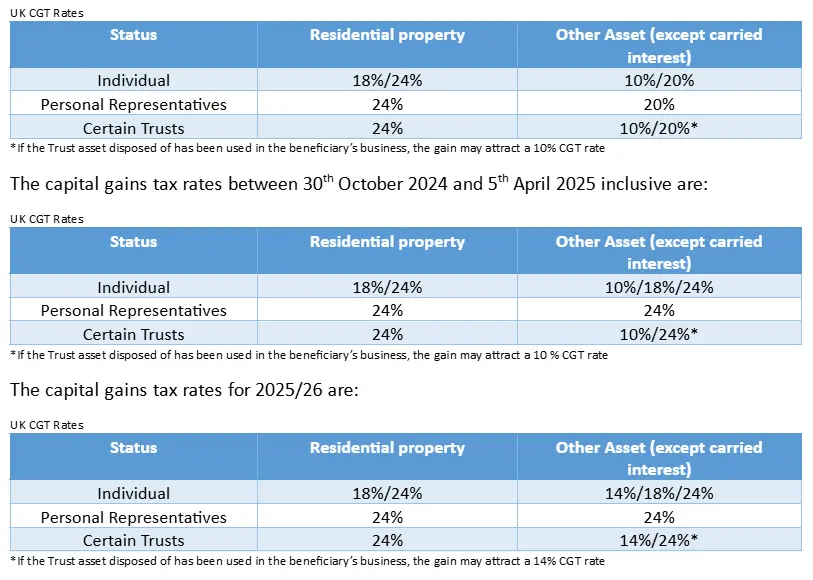
- The rate of CGT for Business Asset Disposal Relief and Investors’ Relief is increasing to 14% for disposals made on or after 6 April 2025, and from 14% to 18% for disposals
made on or after 6 April 2026. - No changes will be made to the 18% and 24% rates of Capital Gains Tax that apply to residential property gains.
- Rules will also be introduced that apply to forestalling arrangements entered into in respect of unconditional but uncompleted contracts before 30 October 2024, and for
Business Asset Disposal Relief and Investors’ Relief, where a contract is made from 30 October 2024 to 5 April 2026 and completed from 6 April 2025. - The Investors Relief (IR) lifetime limit will be reduced from £10 million to £1 million from 30 October 2024 for qualifying disposal made after that date.
The capital gains tax rates pre-30th October 2024 are:
Quick tips
Before you sell an asset, such as shares or property for example, come and speak to us, as there may be planning that can be carried out prior to the sale to mitigate the capital gains tax hit?
Remember, if you are a UK resident taxpayer and sell a UK residential property, which could trigger a gain liable to capital gains tax (CGT), to avoid penalties from arising, you need to complete a CGT Return within 60 days of completion and pay the tax over within the same time frame.
If an inheritance tax (IHT) charge was suffered by a Trust or the settlor of the Trust when an asset was settled into it, and the Trust sells the asset for a taxable gain remember to reduce the gain by the IHT charge.
If a Trust distributes an asset out to a beneficiary and incurs an inheritance tax (IHT) exit charge as a result of doing so, and the beneficiary subsequently sells the asset for a taxable gain they may be able to reduce the gain by the IHT exit charge.
Are you going to receive shares from your employer as a result of your employment? Subject to the way those shares are provided, you could be liable to an immediate income tax charge (in some cases national insurance as well), based upon the actual market value (AMV) of the shares at the time. You and your employer may want to elect, within 14 days of receiving the shares, to be taxed on the unrestricted market value (UMV) instead. More tax is likely to be paid upfront but it may result in considerable overall tax savings further down the line.
Private Equity Profits
- Carried interest is a share of profits earned by investment fund managers or general partners in private equity, venture capital, or certain hedge funds.
- The capital gains tax rate for carried interest will increase from 28% to 32% from April 2025.
- Further reform to the rules will take place from April 2026.
High-Income Child Benefit Charge (HICBC)

- The individual’s High Income Child Benefit Charge (HICBC) adjusted net income threshold will remain at £60,000.
- For individuals with income between £60,000 and £80,000, the rate at which HICBC is charged is halved, and will equal one percent for every £200 of income that is more than £60,000.
- The government will not proceed with the reform announced in the Spring 2024 Budget to base the HICBC on household income.
Quick tips
If an inheritance tax (IHT) charge was suffered by a Trust or the settlor of the Trust when an asset was settled into it, and the Trust sells the asset for a taxable gain remember to reduce the gain by the IHT charge.
If a Trust distributes an asset out to a beneficiary and incurs an inheritance tax (IHT) exit charge as a result of doing so, and the beneficiary subsequently sells the asset for a taxable gain they may be able to reduce the gain by the IHT exit charge.
If you have a child under the age of 12 and register for child benefit you will automatically receive a parent’s state pension credit for each year. If you have a family member who helps you with childcare support whilst you are at work and has a gap in their own national insurance records, you may be able to elect to transfer your state pension credit to them. You can claim from 2011/12 tax year onwards.
If you have separated from your spouse or partner, with the intention for it to be a permanent separation, or if you divorce, then it is important to revisit the child benefit claim. Failure to do so could result in you being hit for the HICBC even though the child may not be living with you.
If you are a single parent or divorced or widowed and a new partner subsequently moves in with you, depending upon their level of income, you may find that they may get hit for the high income child benefit charge. You may want to forewarn them about that.
Did you claim child benefit (CB) before May 2000? The Government have admitted that CB claimants before May 2000 may have lost out on some of their state pension entitlement. This could affect those already in receipt of state pension, deceased estates and those yet to reach state pension age. Each year of error could cost the individual up to £342 (2025/26 tax year figures) per annum in lost state pension entitlement. You may want to check to see if it affects you or your loved ones.
Non-Dom Tax Status

- From 6 April 2025, the current remittance basis of taxation will be abolished for UK-resident non-domiciled individuals.
- This will be replaced with a new 4-year foreign income and gains (FIG) regime for individuals who become UK tax resident after a period of 10 tax years of non-UK residence.
- Qualifying individuals will not pay tax on FIG arising in the first 4 tax years after becoming UK tax resident and will be able to bring these funds to the UK free from any
additional charges. - They will not pay tax on non-resident trust distributions either.
- Individuals, who on 6 April 2025, have been tax resident in the UK for less than 4 years (after 10 years of non-UK tax residence) will be able to use this new regime for any tax year of UK residence in the remainder of those 4 years.
- The protection from tax on foreign income and gains arising within settlor-interested trust structures will no longer be available for non-domiciled and deemed domiciled individuals who do not qualify for the 4-year foreign income and gains regime.
- Transitionally, for Capital Gains Tax purposes, current and past remittance basis users will be able to rebase foreign assets they held on 5 April 2017 to their value at that date when they dispose of them.
- Any foreign income and gains that arose on or before the 5th April 2025, while an individual was taxed under the remittance basis, will continue to be taxed when remitted to the UK under the current rules. This includes remittances by those who are eligible for the new 4-year foreign income and gains regime.
- A new Temporary Repatriation Facility will be available for individuals who have previously claimed the remittance basis. They will be able to designate and remit at a reduced rate foreign income and gains that arose prior to the changes. This includes unattributed foreign income and gains held within trust structures.
- The Temporary Repatriation Facility (TRF) will be available for a limited period of 3 tax years, from 2025/2026. The TRF rate will be 12% for the first 2 years and 15% in the final tax year of operation.
- The measure extends the period of Overseas Workday Relief to 4 years to align with the new 4-year foreign income and gains regime.
- From 6 April 2025, Overseas Workday Relief will be subject to a financial limit on the amount of relief that can be claimed, this is the lower of £300,000 or 30% of an individual’s total employment income.
Quick tips
Where you are in receipt of income or gains from overseas, Tax Treaties between the UK and that particular country may mitigate or wipe out the potential UK tax liability arising on it. In some cases where either the treaty does not cover that particular source of income or gains or the UK does not have a tax treaty with that country, you may be able to claim unilateral relief to mitigate your UK tax liability.
Some UK tax treaties, such as with India and Pakistan can potentially even mitigate a deceased’s estate UK inheritance tax position.
Pensions

- The annual pension allowance will remain at £60,000 for 2025/26.
- The money purchase annual allowance will remain at £10,000.
- The minimum Tapered Annual Allowance will remain at £10,000 for individuals whose adjusted income for the year is £260,000 or more.
- The pension tax-free lump sum remains the lower of 25% of the pension value or £268,275.
- From 30th October 2024, pension transfers from tax-relieved UK pensions to Qualified Registered Overseas Pension Schemes (QROPS) in the EEA and Gibraltar will be subject to a 25% charge, unless another exclusion applies.
Quick tip
If you are a member of a UK-registered pension scheme who is thinking of leaving the UK, you may want to consider topping up your pension scheme in the tax year in which you leave the UK in order to maximise your UK tax relief and enhance your pension provision. This should be done in conjunction with your accountant and a suitably qualified IFA.
One option to consider when wanting to help your children/grandchildren in the future is to contribute up to £2,880 into a stakeholder pension scheme each year. The government will top that up to £3,600. It could help with your inheritance tax position as well.
Individual Savings Account (ISA)
- ISAs will remain unchanged at £20,000 until April 2030.
- Junior ISAs will remain unchanged at £9,000 until April 2030.
- Lifetime ISAs will remain unchanged at £4,000 until April 2030.
- Child Trust Funds will remain unchanged at £9,000 until April 2030.
State Pension (SP)

- Under the triple lock, SP rises in line with the highest of average earnings, inflation or 2.5% based upon September 2024 figures.
- The highest figure was earnings growth.
- The SP will increase by 4.1 % from April 2025.
- The weekly full state pension will increase from £221.20 to £230.30 from April 2025.
Quick tip
Consider making voluntary national insurance contributions to fill gap years in your state pension history. Up until 5th April 2025, you can go as far back as April 2006. Each year would cost you just over £824. After that date, you can only go back 6 tax years. The cost for each year would then be based upon the voluntary Class 3 national insurance rate applicable for that current year. Each additional year could result in an extra £342 state pension (based upon 2025/26 figures) on an annual basis.
Inheritance Tax (IHT)

- The IHT rate will remain at 40% and the Chancellor has frozen the £325,00 IHT Nil Rate Band and the £175,000 Residence NIL Rate Band (RNRB) until April 2028.
- The commencement of the tapering off of the RNRB will remain at £2 million.
- Inherited pensions will fall within a person’s estate for IHT purposes from April 2027.
- Agricultural Property Relief (APR) is a relief from IHT available on the agricultural value of land and other property that is owned and occupied for the purposes of agriculture.
- Business Property Relief (BPR) is a relief from IHT available on the value of certain business assets.
- From April 2026 only the combined value of APR and BPR of £1 million will attract 100% IHT relief. Any value in excess of that limit will attract 50% IHT relief.
- Alternative Investment Market shares will only attract 50% IHT relief if held by the deceased for at least 2 years prior to death from April 2026.
- From 6th April 2027 unused pension funds and death benefits payable from a pension will be brought into a person’s estate for IHT purposes.
- As part of these changes, pension scheme administrators will become liable for reporting and paying any inheritance tax due on unused pension funds and death benefits.
Quick tips
Did the deceased gift an asset away within 7 years prior to death but the value of it was lower at the time of death? Normally the market value at the date of the gift comes back into the deceased’s estate for inheritance tax purposes. However, if the value was less at the time of death you can make a loss relief claim and use that value instead to
mitigate the inheritance tax burden.
If the gross sale value of land or property sold within 4 years of the deceased’s death turns out to be less than the probate value, you may want to consider putting in an inheritance tax loss relief claim. You could do the same, if, within 12 months of death, the disposal of listed shares or unit trusts resulted in the gross sale value being less than at probate.
If you are self-employed and your taxable profits are below £6,725 (2024/25 tax year) or £6,845 (2025/26 tax year), you may want to consider paying voluntary Class 2 NI as opposed to voluntary Class 3 NI as it will be considerably cheaper and will enable you to continue to have access to contributory benefits, including the state pension.
If a person who gifted a business asset away dies within 7 years of making the gift and that triggers an inheritance tax (IHT) charge, and the recipient of the gift subsequently sells the asset for a taxable gain, they may be able to reduce the gain by the IHT charge incurred.
Annual Tax on Enveloped Dwellings (ATED)
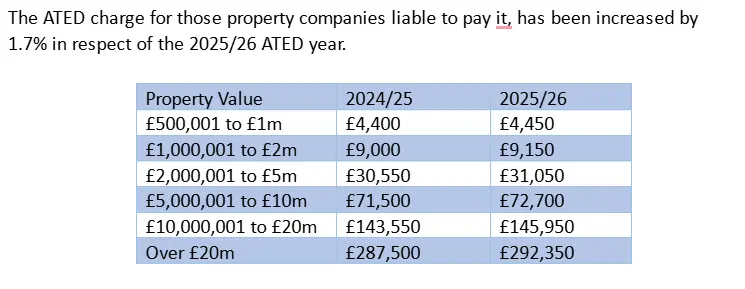
- The ATED charge for those property companies liable to pay it, has been increased by 1.7% in respect of the 2025/26 ATED year.
Quick tip
Do you own or have an interest in residential property through a corporate vehicle? Was the value of the property, as of 1st April 2022, worth more than £500,000 or did you acquire it after that date for more than that amount? Even if you rent the property out on a commercial basis, you still need to complete an ATED return within 30 days of acquiring the property. If a corporate has constructed a new build or converted an existing property into a dwelling then it has 90 days from the completion date or the date it is first occupied, if earlier, to complete the ATED return. An ATED return should then be completed by 30th April each year otherwise penalty charges of up to £1,600 per property could arise.
Taxation of company cars

- Appropriate percentages for zero-emission and electric vehicles will increase by 2% per tax year in 2028/29 and 2029/30, rising to an appropriate percentage of 9% in tax year 2029/30.
Quick tips
Before considering whether to buy or lease a car through the company or do so personally, why not have a review of the tax and national insurance impact on both you and the company before reaching that decision.
- Appropriate percentages for all cars with emissions of 1 to 50g of CO2 per kilometre, including hybrid vehicles, will rise to 18% in the tax year 2028/29 and 19% in the tax year
2029/30. - Appropriate percentages for all other vehicle bands will increase by 1 percentage point per year in tax years 2028/29 and 2029/30. This will be to a maximum appropriate percentage of 38% for tax year 2028/29 and 39% for tax year 2029/30.
Van Benefit and Car and Van Fuel Benefit
- The van benefit charge will be £4,020 and fuel benefit charge £769 in the 2025/26 tax year.
- The car fuel benefit charge multiplier will be £28,200 in the 2025/26 tax year.
- The Government will no longer maintain the treatment of double cab pick-up vehicles with a payload of one tonne or more as goods vehicles.
- HMRC is updating guidance to clarify the position in respect of such vehicles which will be treated as cars for capital allowances, for benefits in kind, and for some deductions from business profits. Transitional arrangements will also apply.

Vehicle Excise Duty (VED)
- The Budget announced VED first year rates for new cars registered on or after 1 April 2025.
- Zero emission cars will pay the lowest first year rate at £10 until 2029/30.
- Rates for cars emitting 1g/km to 50g/km of CO2, including hybrid vehicles, will increase to £110.
- Rates for cars emitting 51g/km to 75g/km of CO2, including hybrid vehicles, will increase to £130.
- All other rates for cars emitting 76g/km of CO2 and above will double from their current level.
Employee Ownership Trusts (EOT)
- There is a tightening of the EOT rules as regards disposals made to the trustees of an EOT on or after 30 October 2024.
- The revised tax treatment for contributions made to an EOT to repay the former owner and the changes to the Income Tax relief conditions for annual bonus payments to employees of EOT-controlled companies also has effect from 30 October 2024.
- Legislation will be introduced to restrict former owners or persons connected with former owners from retaining control of companies post-sale to an EOT by virtue of control (direct or indirect) of the EOT.
- Trustees of an EOT must be UK resident (as a single body of persons) at the time of disposal to the EOT.
- Trustees must take reasonable steps to ensure that the consideration paid to acquire the company shares does not exceed market value.
- If qualifying conditions surrounding the EOT are breached, the timeframe to clawback tax relief from the vendor has been extended to the end of the 4th tax year following the end of the tax year of disposal.
- A requirement that individuals provide within their claim for Capital Gains Tax relief information on the sale proceeds and the number of employees of the company at the time of disposal.
Quick tip
If you are thinking of exiting your business within the next five years there are a number of options open to you. Planning of this ilk should start early. Please do not hesitate to contact us if you want to look at the various options and the impact of each one.

Employee Benefit Trusts (EBT)
- The changes to the Employee Benefit Trust Inheritance Tax regime will have effect from 30 October 2024.
- Restrictions on connected persons benefiting from an EBT must apply for the lifetime of the trust.
- The Inheritance Tax exemption will be restricted to where the shares have been held for two years prior to settlement into an EBT.
- No more than 25% of employees who can receive income payments should be connected to the participator in order for the EBT to benefit from favourable tax treatment.
Cultural Reliefs
- With effect from 1st April 2025, companies that qualify for the Audio-Visual Expenditure Credit (AVEC), will be able to claim an enhanced 39% rate of AVEC on their UK visual effect (VFX) costs (increased from 34%).
- The AVEC’s 80% cap on qualifying costs will be removed for UK VFX costs. Qualify VFX costs incurred from 1 January 2025 will be eligible.
Tax Avoidance
- With effect from 30th October 2024 there is a tightening of the anti-avoidance rules regarding company loans to participatory.
- Where companies and their shareholders are attempting to avoid the s455 loan charge, tax is payable whether or not there has apparently been a repayment, or a repayment is subsequently made.
- From 30th October 2024, a tax charge will arise where a Limited Liability Partnership (LLP) is liquidated, and assets are disposed of to the contributing member, or a person
connected to them. The tax liability will arise on the chargeable gains made at the time the asset was contributed to the LLP. - The government will introduce legislation in a future Finance Bill to close loopholes in employee car ownership schemes to prevent them from being used to circumvent the company car tax benefit in kind charge.
- Legislation will be introduced in a future Finance Bill to prevent abuse of the charity tax rules by strengthening several existing anti-abuse rules to ensure that only the intended tax relief is given. These changes will take effect from April 2026 to give charities time to adjust to the new rules.The government will introduce legislation in a future Finance Bill to make agencies
responsible for accounting for PAYE on payments made to workers that are supplied
using umbrella companies. Where there is no agency, this responsibility will fall to the
end client business. This will take effect from April 2026.

Corporation Tax
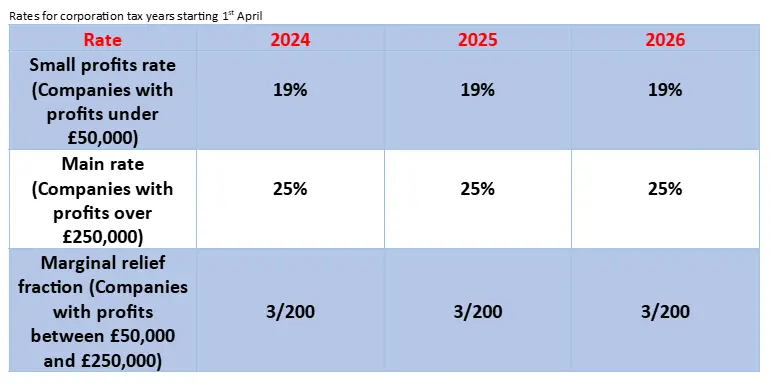
- The corporation tax rates for those companies who do not make profits from oil extraction or oil rights in the UK or UK continental shelf have not been changed in respect of the financial year 2025 (starting 1 st April 2025) and will also remain for the financial year 2026 (starting 1 st April 2026).
It is as follows:
Quick tips
A charity or Community Amateur Sports Club may be able to claim 25% on cash or contactless card donations of £30 or less up to a maximum of £2,000 in relief, without the need to keep individual donor records under the Gift Aid Small Donation Scheme.
Are you looking to reward employees who have been with you for more than 20 years? You can provide long service gifts which can be free of tax for the employee. The gifts can be worth up to £50 for each year of service up to a maximum of 20 years and should be the first in the last 10 years, and not cash.
If you are an employer considering providing a one-off/exceptional payment to your lower-paid employees to mitigate the impact of the cost of living crises, then it may be better to do so in the form of non-cash vouchers, as opposed to cash itself, as it will not impact upon their universal credit payments.
Are you an employer who retains an element of the tips, gratuities, or service charges to meet any employer’s national insurance liability that may arise in respect of that income? Be aware that the Employment (Allocation of Tips) Act came into force from 1st October 2024. Under the legislation, an employer will not be able to retain any
monies of this ilk, as it all has to be paid out to the employee.
Consider setting up an independently controlled Tronc scheme which should help you avoid suffering the employer’s national insurance liability in the first place. Be aware that tips, gratuities, or service charges allocated to the employees do not count as wages when applying the national minimum wage legislation.
Consider the option to payroll benefits in kind (except for beneficial loans and accommodation) thereby potentially avoiding the legal requirement to complete and submit forms P11D. You must apply to do so prior to 6th April 2025 if you want to adopt this approach as regards the 2025/26 tax year. Please note that payrolling benefits will become compulsory from 6th April 2026 onwards.
There are a number of approved share option schemes, as well as the non-tax advantages share scheme arrangements, which should all be considered when looking at incentivising employees, before deciding which, if any, is appropriate for your business. There are pros and cons to each type of incentive arrangement, both for the employer and the employee.
VAT

- The taxable turnover threshold for determining whether a business must register for VAT remains at £90,000 and the point at which a business can apply to deregister will also remain at £88,000.
- All education services and vocational training supplied by a private school or a ‘connected person’ for a fee will be liable to VAT at the standard rate of 20% starting on or after 1 st January 2025.
- Board and lodging services closely related to such supplies will also be liable to VAT at 20%, including when supplied by a ‘connected person’.
- Any school fees paid on or after 29th July 2024 relating to the period from 1st January 2025 will also be liable to the standard rate of VAT.
- The provision of nursery services to children below school age will remain VAT exempt as will state school education and sixth form colleges where no fee is charged.
- Where a Special Education Needs place is provided at a private school and is funded by a local authority (LA) or similar body, the LA will be able to claim a VAT refund on the fees charged.
Quick tips
Where, in the past, private schools have suffered irrecoverable VAT on large capital projects, there may be some circumstances where the school could look back at that expenditure and possibly start recovering the VAT incurred under the Capital Goods Scheme.
If a business deregisters for VAT purposes, it must account for output tax on unpaid sales invoices on its final VAT Return. However, if at a later date (up to 4 years), some sales are written off as they are not expected to be paid by the customer then bad debt relief can be claimed.
If you are VAT registered and sell second-hand goods, works of art, antiques, or collector items to non-VAT registered customers, either directly or through an auction, see if you are eligible to use one of the 3 VAT Margin Schemes. A potential win-win for both you and the customer.
When first registering for VAT, you may be able to claim input VAT on goods purchased in the 4 year period before registration where those goods have been used in the business and are still owned on the first date of registration.
This includes both stock and assets. When first registering for VAT, you may be able to claim input VAT on services purchased in the previous 6 months for business purposes, unless already recharged to a customer prior to registration. If the supplies you make are outside the scope of UK VAT (e.g. a provision of services to an overseas customer), but they would be taxable VAT supplies if they were made in the UK, then VAT input tax on expenditure incurred in relation to that supply may be claimed back.
If you are a partially exempt business for VAT purposes, you normally cannot claim the VAT input tax on costs attributable to any VAT-exempt supplies that you make. However, if the total value of your exempt input tax is not more than £625 per month on average and it represents no more than 50% of your total VAT input tax then this can be recovered.
Capital Allowances
- This Budget has not changed the ability for companies to claim a 100% first-year allowance (FYA) for main rate expenditure (known as Full Expensing) and 50% FYA for special rate expenditure. These allowances are only available to companies.
- The 100% Annual Investment Allowance deduction for expenditure incurred of up to £1 million in purchasing plant & machinery also remains in place.
- The 100% FYA for qualifying expenditure on zero-emission cars and on plant or machinery for electric vehicle charge-points has been extended to 31 st March 2026 for
Corporation Tax purposes and to 5th April 2026 for Income Tax purposes.
Quick tips
Are you a company that has acquired a major interest in a contaminated brownfield site? If so, you may be entitled to land remediation relief (LRR) of up to 150% for expenditure incurred in carrying out remediation work on that land.
If you are a loss-making firm you may be able to surrender the LRR for a tax credit equal to 16% of the qualifying
land remediation costs.
Research & Development (R&D) and Patent Box

- There are no changes to the R&D rules following the merger of the R&D tax relief scheme for small and medium-sized companies and the R&D expenditure credit (RDEC) used by large companies for accounting periods beginning on or after 1st April 2024.
- The SME rules restricting relief where part of the project expenditure has been subsidised have been removed.
- Loss-making SME companies claiming R&D relief are eligible for a higher payable credit rate of 14.5% if they meet the definition for R&D intensity.
- For accounting periods beginning on or after 1st April 2024, the intensity threshold is 30%.
- There is a one-year grace period that allows a company which fails to meet the intensity threshold, for example, due to a one-off shock or small fluctuations in expenditure (for
companies close to the threshold), to continue claiming the enhanced support in that
year if it met the intensity threshold and successfully claimed enhanced support in the
previous year.
Quick tips
The R&D criteria is quite wide, and many eligible companies are missing out on it. Since 1st April 2023, you only have 6 months from the end of the accounting period in which R&D activity has occurred to make a claim, unless you have made a similar claim in the previous 3 years. If in doubt, ask for a free R&D check to see if a legitimate claim can be made.
Ignoring the cost of the land, where you have incurred the cost of acquiring a property that is used for R&D purposes, you may be entitled to a 100% first-year allowance. Where the R&D part of the building represents 75% or more of it, the 100% applies to the full cost. If less than 75% it is apportioned.
If your company is carrying out innovative work is it worthwhile applying for a patent? Bearing in mind the increase in the corporation tax rates, the benefit of having a patent or you exclusively license the rights to those patents, could result in the associated profits tied to the patent attracting a corporation tax rate of only 10%.
National Minimum Wage (NMW) and National Living Wage (NLW)
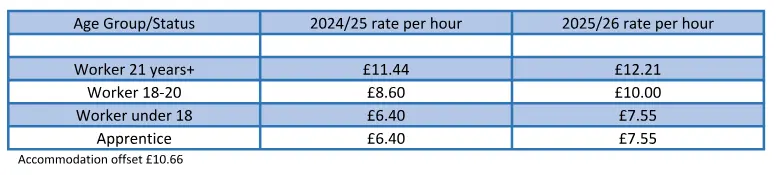
- A reminder that the NMW and NLW are due to increase from the beginning of April 2025.
Quick tip
Businesses need to be careful that they do not fall foul of the NMW complex legislation as penalties can be exceedingly high. One should carry out an NMW review to ensure that the business is NMW compliant. Please do not hesitate to contact us if you require assistance.
Stamp Duty Land Tax (SDLT) – England & Northern Ireland

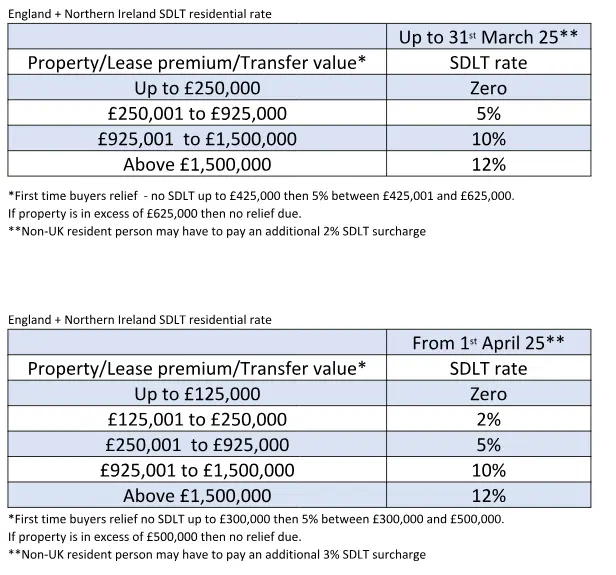
- The temporary SDLT residential rates and thresholds which applied from 23rd September 2022 comes to an end on 31st March 2025.
- The SDLT residential rates and thresholds in existence immediately prior to that date will apply from 1st April 2025.
- A non-UK resident person will continue to pay an additional 2% SDLT on a UK property purchase.
- The SDLT surcharge on acquiring an interest, in excess of £40,000, in a second residential property increase from 3% to 5% from 30th October 2024.
- Corporate bodies purchasing residential property valued at more than £500,000 will be charged SDLT at 17% from 31st October 2024, unless an applicable relief applies.
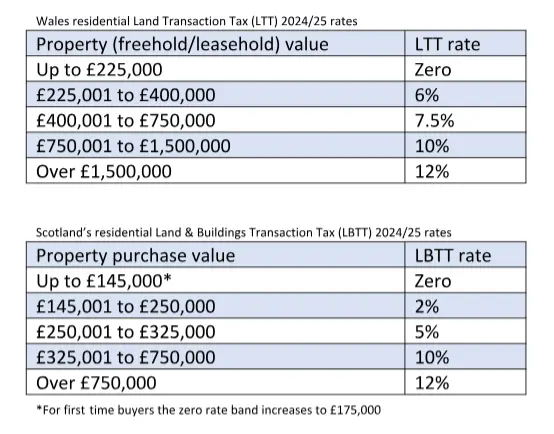
- The Devolved Parliaments of Wales and Scotland set their own land transaction tax rates.
Quick tips
Don’t forget that if you have incurred the 3% SDLT Surcharge or subsequent 5% SDLT Surcharge (England and Northern Ireland) or the Welsh 4% Land Transaction Tax Higher Rate charge upon acquiring a new main residence but before having disposed of your previous one, then you may be able to claim a refund if you sell your old property within 36 months of purchasing the new one.
Don’t forget that if you incurred the Scottish 6% Additional Dwellings Supplement upon acquiring a new main residence before having disposed of your previous one, then you may be able to claim a refund if you sell your old property within 36 months of purchasing the new one. This timeframe was increased from 18 months to 36 months from 1st April 2024.
If you are buying 6 or more residential properties in a single or linked transaction, you could apply the commercial rate of land taxes against the purchase price, rather than the residential rate. This may avoid the additional higher rate residential land taxes.
Business Rates (England)
- The government will introduce permanently lower business rates for retail, hospitality and leisure businesses from 2026-27. Until then they will receive 40% relief on business rates up to a cap of £110,000.
Vaping Product Duty (VPD) + Tobacco Duty (TD) Rates + Alcohol Duty (AD)
- With effect from 6pm on 30 th October 2024 duty rates for all tobacco products will increase using the TD escalator by 2% above inflation (based on the Retail Price Index (RPI)).The rate for hand-rolling tobacco by an additional 10% above the escalator, to 12% above RPI.
- There will be a one-off TD increase of £2.20 per 100 cigarettes or 50 grams of tobacco, effective from 1 October 2026.
- With effect from 1 st October 2026 there will be a single VPD rate of £2.20 per 10ml of vaping liquid.
- AD rates on draught products below 8.5% alcohol by volume (ABV), will be cut by 1.7%, so that an average ABV strength pint will pay 1 pence less in duty.
- AD rates on non-draught products will increase in line with RPI inflation.
- These AD measures will take effect from 1 February 2025.
Air Passenger Duty (APD)

- For 2025/26 the reduced rates for economy passengers will increase in line with RPI, rounded to the nearest pound.
- For 2026/27 all rates will be increased by 13%, rounded to the nearest pound.
- For 2026/27, the higher rates that apply to larger private jets will increase by a further 50%.
Fuel Duty
- The Chancellor will extend the 5 pence cut in the rates of Fuel Duty first introduced at Spring Statement 2022 until 22nd March 2026.
Infrastructure Spending
- The Government has changed its self-imposed debt rules in order to free up £50 billion for infrastructure spending.
- The National Audit Office and the Office for Budget Responsibility will be asked to validate the investments made.
- The extra room for manoeuvre for spending on investment projects will not be able to be used for extra day-to-day spending, as this will need to be funded from tax receipts.
- There will be £500 million in new funding to help build up to 5,000 social homes and bring total investment in housing supply to £5 billion as part of the government's Affordable Homes Programme.
- The existing social housing stock will also be protected by reducing Right to Buy discounts so that thousands more council homes remain in the sector.
- A further £1.4 billion will be allocated to rebuild crumbling schools.

Further Announcements
- To help support aims to reduce waiting times, there will be an additional £1.5 billion capital investment into new surgical hubs and scanners, alongside £70 million for new radiotherapy machines.
- £1.8 billon will be allocated for the expansion of government-funded childcare, with a further £15 million of capital funding for school-based nurseries.
- The first stage of the plan will pay for 300 new or expanded nurseries across England.
- The government will triple investment into free breakfast clubs to £30 million in 2025/26.
- From the beginning of next week the subsidised £2 bus fare cap will be increased to £3.
- The subsidy was due to come to an end in December this year but the government has extended it for a further year.
- The Chancellor has raised the limit people can earn before being ineligible for the Carers Allowance from £151 a week to £181.
- To keep more children in stable and loving homes, £44 million of funding has been announced to support kinship and foster carers.
- £240 million Get Britain Working package to include work, skills and health support for disabled people and the long term sick has been announced.
- Benefit reform will be accelerated this year, with 800,000 people on the old Employment and Support Allowance (ESA) benefit to be moved onto Universal Credit (UC) from this autumn instead of 2028.
- The Energy Profits Levy will increase from 35% to 38% from 1 st November 2024 until 31 st March 2030.
- The alternative finance (AF) legislation is amended, with effect from 30 th October 2024, to ensure that where an existing asset is used as a means to raise finance using AF, the tax outcome is broadly the same as conventional financing.
- The government is extending the employer National Insurance contributions relief for employers hiring qualifying veterans for a further year from 6 April 2025 until 5 April 2026.
- The late payment interest rate charged by HMRC on unpaid tax liabilities will increase by 1.5% from April 2025.
- The Help to Save Scheme will be extended a further two years to 5 th April 2027.
- Making Tax Digital (MTD) for Income Tax will be extended to sole traders and landlords with income over £20,000 by the end of this Parliament.
Quick tips
Are you an Executor/Executrix dealing with the estate of a deceased person? If the deceased made a capital loss in the tax year they died, you may be able to carry back the loss and set it against taxable gains in the previous 3 tax years.
If you are selling a residential property which might trigger a capital gains tax liability, consider if the legatees are entitled to 75% or more from the net proceeds of sale and have occupied the property as their main residence pre and post the date the deceased died. If so, main residence relief may be due.
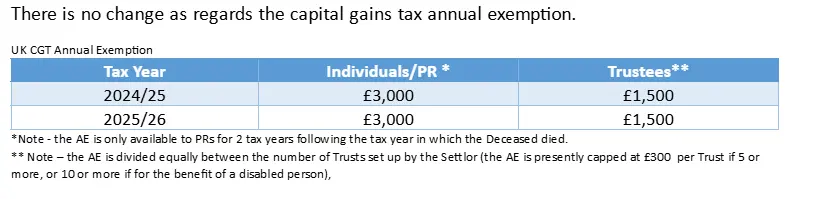
If you are contemplating selling an estate asset which is pregnant with gain, you may wish to consider the timing of yhe sale in order to mitigate the capital gains tax liability. The estate is eligible for the full capital gains tax annual exemption for the year of death and the following two tax years. After that, no entitlement.
If you are setting up a Trust remember that in the vast majority of cases you will need to register its existence with HMRC through the Trust Registration Service. Failure to do so can result in penalties arising.
Remember with most Trusts there is a potential 6% inheritance tax charge on each 10 th anniversary the trust is in existence based upon the market value of the assets at that date. It is wise to review the Trust well in advance of that deadline to consider whether or not to distribute the assets before that date as the pro-rated 6% charge will be based upon the market value at the previous anniversary date.

